Wise vs Remitly vs Xoom: Which Gives More INR?
How we produce this guide: we track live USD → INR pricing across major remittance providers, rank them by the rupees actually received after fees and exchange-rate margin (not the headline rate), and refresh figures as the market moves. See our full methodology.
Disclosure: this site shows ads and may, now or in future, earn a referral commission if you sign up with a provider through a link — at no extra cost to you. It never affects our rankings. See our terms & disclaimer.
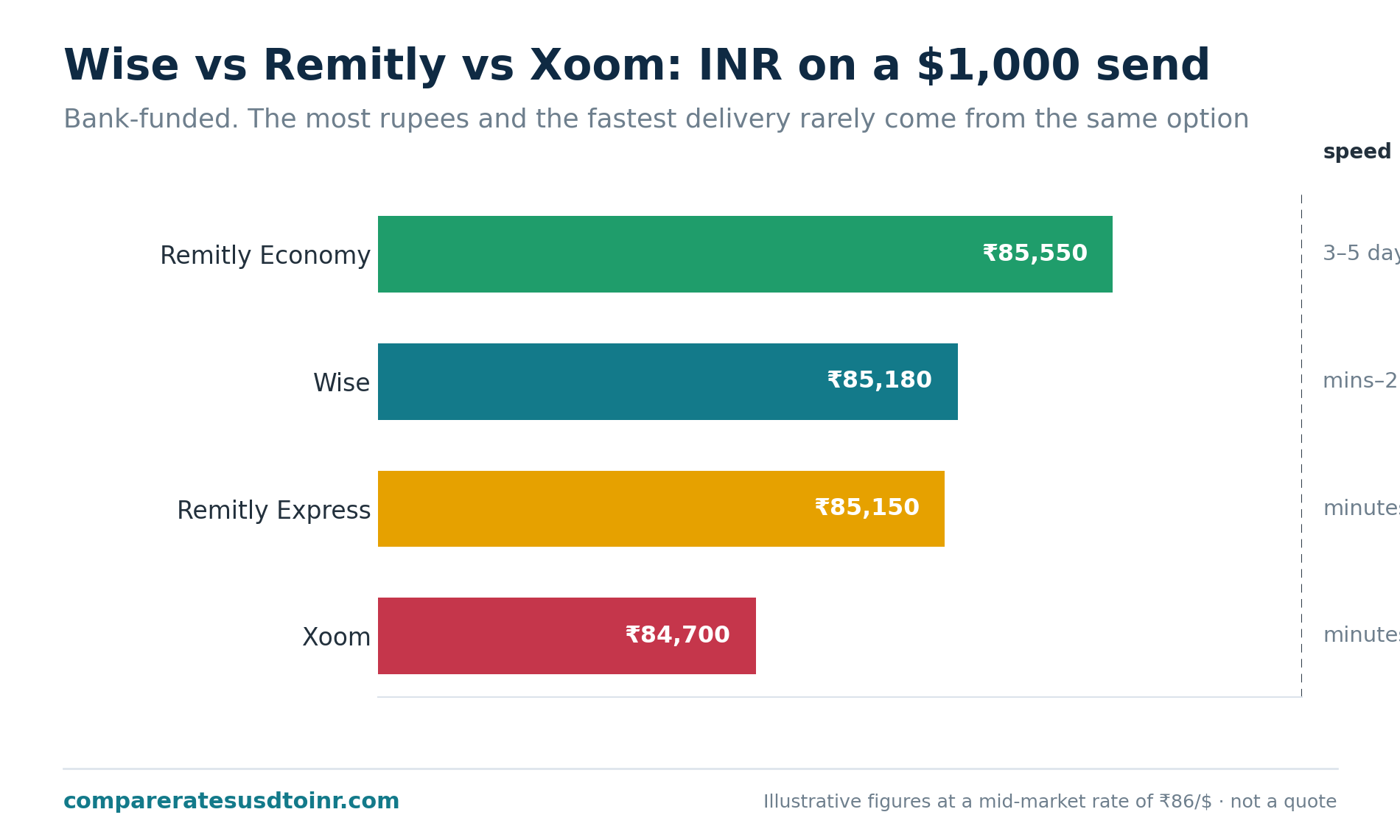
Three apps, the same $1,000, three different amounts landing in India. That's not a glitch — it's the entire reason this comparison exists. People assume the big-name services are roughly interchangeable, then wonder why their cousin received ₹81,000 through one app and a colleague's family got ₹82,500 through another on the same day.
The honest answer up front: there's no permanent winner. The cheapest of these three flips depending on the amount, the funding method, the delivery speed you choose, and whatever promotion is running that week. But the way each one is built is different enough that you can predict, for your situation, which is likely to come out ahead. Let me break down how each behaves, then run the actual numbers.
How each one makes its money
This matters more than any feature list, because it tells you where the cost hides.
Wise (formerly TransferWise) built its whole brand on one promise: it gives you the real mid-market rate — the exact midpoint you'd see on a currency chart — and charges a separate, visible fee. Nothing is buried in the rate. On a USD→INR transfer that fee typically lands somewhere around 0.4% to 0.7% of the amount, depending on how you pay. The appeal is transparency. You always know exactly what the conversion cost you, because it's printed as a line item rather than smuggled into a worse rate.
Remitly runs a two-speed model, and this confuses people constantly. Its Economy option is cheap — a small margin baked into the rate, slower delivery. Its Express option is faster but carries a wider margin. So "Remitly's rate" isn't one number; it's two, and the gap between them can be meaningful. Remitly also leans hard on first-transfer promotions and high delivery flexibility, including cash pickup and UPI, which Wise doesn't offer into India. For the full breakdown of its two tiers and pricing, see Remitly USD to INR.
Xoom, owned by PayPal, takes the more traditional route: it advertises "no transfer fee" on many India transfers, and earns its margin through the exchange rate instead. That's not a criticism — it's a pricing choice — but it means the Xoom rate sits further from the mid-market rate than Wise's. The trade-off you're buying with Xoom is the PayPal ecosystem, speed, and a wide set of delivery options including cash pickup. For a closer look at how its rate and fees behave, see Xoom USD to INR.
So in plain terms: Wise shows you the cost openly, Remitly lets you choose your cost via speed, and Xoom folds the cost into the rate and calls the fee zero. Once you see that, the comparison stops being mysterious.
A worked example on $1,000
Let's run the math the only way that's honest — by looking at rupees delivered, not fees advertised. Assume the real mid-market rate is ₹86.00 to the dollar, and you're funding from your US bank account (the cheapest method on all three). These are representative figures, not live quotes; the relationships between them matter more than the exact digits.
| Service | Rate given | Fee | INR delivered on $1,000 | Typical speed |
|---|---|---|---|---|
| Wise | ~₹85.70 (≈0.35% off) | ~$6 | ~₹85,180 | Minutes–2 days |
| Remitly Economy | ~₹85.55 (≈0.5% off) | $0 (over $1k) | ~₹85,550 | 3–5 days |
| Remitly Express | ~₹85.15 (≈1% off) | $0 (over $1k) | ~₹85,150 | Minutes |
| Xoom | ~₹84.70 (≈1.5% off) | $0 | ~₹84,700 | Minutes–1 day |
A few things jump out. Remitly Economy often edges ahead on raw rupees for larger amounts because it waives the fee and keeps a tight margin — but you pay for it in waiting days. Wise is consistently strong and predictable, and it's usually the most transparent. Xoom tends to deliver the least on a pure-cost basis, with speed and the PayPal connection as its draw. And Remitly Express sits in between — fast, but you give back some of the rupees for that speed.
Notice that the "best" answer already depends on what you value. Need it instant? Remitly Express or Xoom. Want the most rupees and can wait? Remitly Economy or Wise. Want zero guesswork on what it cost? Wise, every time.
Where each one genuinely shines
Reach for Wise when you care about transparency and you're sending to a bank account. Its rate is the closest thing to "fair" you'll find, it's excellent for slightly larger personal transfers, and the app makes the true cost impossible to hide. It also doubles as a multi-currency account, which is handy if you juggle USD and INR regularly. The catch: Wise doesn't do cash pickup into India, so it's bank-account-only.
Reach for Remitly when you want options. The Economy/Express split lets you trade speed for cost on a per-transfer basis, which no other major app does as cleanly. Its first-time promotions are often the most generous of the three, and it supports cash pickup, UPI, and home delivery in some areas. If you send to family who sometimes need cash and sometimes need a bank deposit, Remitly's flexibility is the selling point.
Reach for Xoom when you already live in the PayPal world, want a familiar name, or need a fast, simple send without thinking about tiers. It's smooth and quick. Just go in knowing the cost is in the rate, so compare the delivered rupees before assuming "no fee" means cheapest.
The funding method changes everything
One detail overrides a lot of the above: how you pay. All three charge more — sometimes a lot more — for debit and especially credit card funding than for a bank/ACH transfer. A credit card can also trigger a cash-advance fee from your card issuer. If you fund a transfer with a card, a "cheap" service can instantly become the expensive one.
The rule of thumb: bank-funded and patient beats card-funded and fast, on cost. If you can wait a day or two and pull from checking, do that. Reserve card funding for genuine emergencies.
Limits, verification, and the things people forget
Each service caps how much you can send, and the caps rise as you complete more identity verification. Wise's limits are generally high for verified users. Remitly's depend on your account tier and history. Xoom's sit lower for new users and climb over time. If you're planning a large transfer, verify your account fully before you start, or you'll hit a ceiling mid-send. For sizable amounts, our piece on large money transfers to India covers the reporting side too.
Delivery options also differ. Wise: bank deposit and UPI. Remitly: bank deposit, cash pickup, UPI, sometimes home delivery. Xoom: bank deposit, cash pickup, debit-card deposit. If your recipient's needs are specific, that can decide the matter before price even enters the picture. Cash pickup vs bank deposit goes deeper on choosing a method.
The amount changes the answer
A detail people miss: the best of the three flips depending on how much you send. On a small transfer — say $200 to cover something quick — a flat fee hurts proportionally more, so a service that waives the fee or has a tiny one can win even with a slightly worse rate. The rate margin on $200 is small in absolute rupees, so the fee dominates. On a small send, a fee-free option (Remitly Economy over its threshold, or Xoom's no-fee structure) often comes out ahead despite a wider margin.
Flip to a $5,000 transfer and the logic reverses completely. Now the rate margin is the giant, and the fee is a rounding error. A 1.5% markup on $5,000 is roughly ₹6,500 — dwarfing any $5 fee. Here Wise's tight, transparent margin tends to pull clearly ahead, and the gap between it and Xoom can be several thousand rupees. The lesson: don't assume the service that won your last small transfer wins your next big one. Re-check at the amount you're actually sending.
Here's the pattern in one line. Small amounts: favor low or zero fees, and the margin barely matters. Large amounts: favor the tightest rate margin, and the fee barely matters. The crossover sits somewhere in the low-thousands of dollars, which is exactly the range where it's worth comparing delivered rupees rather than guessing.
Reliability, support, and the things rates don't capture
Cost isn't everything, and on transfers that matter, the boring stuff earns its keep. All three are established and reliable, but they differ in texture. Wise's app and tracking are widely considered the cleanest, with clear status updates and predictable timing. Remitly's customer support and phone availability are a genuine strength when something goes wrong mid-transfer, which matters more than people admit until they need it. Xoom benefits from PayPal's scale and dispute infrastructure, and the familiarity is reassuring for less tech-comfortable senders — handy if you're setting up an account on behalf of a parent.
Verification limits also differ in practice. Xoom tends to start new users with lower ceilings that climb over time, while Wise and Remitly can raise limits faster for fully verified accounts. If you have a large send coming up, the service that lets you push it through in one transfer, rather than splitting across days, is worth choosing on convenience alone.
My honest take
If I had to pick one as a default for someone who just wants a good deal without fuss, I'd lean Wise — because it never hides the cost, the rate is reliably close to fair, and you don't have to decode tiers. For people who send to family with varied needs and love chasing the best deal, Remitly rewards the effort with its Economy tier and promos. Xoom earns its place mostly on speed, the PayPal link, and brand comfort, but it asks you to accept a rate-based cost in exchange.
The smartest move isn't loyalty to one app. It's keeping two installed and checking the delivered-rupees figure on both before any transfer that matters. The winner shifts, and ninety seconds of comparison can be worth a thousand rupees. The mechanics of that comparison are in how much INR you'll receive after fees, and the broader landscape — including options beyond these three — is in best ways to send money from USA to India.
Setting up your first transfer cleanly
Whichever of the three you land on, the first send goes smoother with a little prep. Verify your identity fully in the app before you need to send anything urgent — a first transfer can be held briefly for review, and you don't want that happening when a bill is due. Add your recipient's bank details carefully and double-check the account number and IFSC code; a tiny test transfer of $20 to confirm it arrives in the right account is cheap insurance. Fund from your US bank account rather than a card to keep the cost down, and save the recipient so future sends take seconds.
It's also worth remembering that these three aren't your only options. For cash pickup into rural areas, retail operators like Western Union or Ria may serve places the apps don't, and for sending into your own NRE or NRO account, an Indian bank's remittance arm can be convenient. The full landscape is laid out in best ways to send money from USA to India, and the broader playbook — funding, timing, limits, and traps — lives in the complete guide to sending money from the USA to India. If you ever suspect a service is quietly overcharging through the rate, hidden fees in USD to INR transfers shows you how to catch it, and for timing your conversions, best time to convert USD to INR covers what actually helps.
Sources & further reading
- Wise: Pricing and fees
- Remitly: How fees and exchange rates work
- Xoom (a PayPal service): Fees and exchange rates
- Reserve Bank of India: Foreign Inward Remittances
- IRS: Gifts from foreign persons (Form 3520 reporting)
Frequently asked questions
Does Wise or Remitly give a better exchange rate? Wise gives the mid-market rate with a separate visible fee, so its rate is technically the "best" (no markup). Remitly bakes a small margin into its rate. On delivered rupees, Remitly Economy can sometimes match or beat Wise for larger amounts because it waives the fee, but it's slower. Compare the final INR for your exact amount.
Which app is cheapest for sending money to India? It varies by amount, speed, and promotions. For bank deposits where you can wait, Wise and Remitly Economy usually lead. Xoom is rarely the cheapest on pure cost but wins on speed and convenience. Always compare delivered rupees, not the advertised fee.
Is Xoom owned by PayPal? Yes. Xoom is a PayPal service, which is why you can fund Xoom transfers with a PayPal balance and why it integrates with the PayPal account you may already have.
Which transfer service is fastest to India? For bank deposits, Remitly Express and Xoom are typically near-instant to a few hours, and Wise can be fast too depending on the corridor. Economy options trade speed for a better rate and take a few days.
Figures here are illustrative and change daily. This is general information, not financial advice — check live quotes in each app before transferring.
Figures in this article are illustrative examples to show how the math works — they are not live quotes and change daily. See the live USD → INR rates for current numbers, and always confirm the final amount on the provider’s own site before you send.